
15 years ago, I started this blog with the intention of doing my part to provide a voice of balanced reason into a fitness industry that knew nothing but extremism. It was also an industry that was quick to share harmful opinionated judgement, which discouraged many to get into the gym to regard their fitness and health.
Today, things have certainly changed for the better. That deserves praise.
More balanced nutritional advice, realistic goal-setting and more human body ideals are being broadcast on public platforms. Women can be found in the gym more than ever, and lifting weights, no less. Function and capability in older age has become something people strive for.
Though the reach is not only greater than before, it’s still being eclipsed by other movements that completely miss the forest for the trees.
Thinking for Ourselves is Extinct
Ignore the fact that you’re reading this on a blog page known for its solipsism for a second. I get it. The irony is strong.
So much of our behavior as adults is now defined – or at the very least, judged – by some made-up standard set on (or by) social media and the internet. It’s been a slow trickle that’s fed people enough to diminish their ability to think contextually or for themselves at all. For that reason, gone are the days where a ‘case-by-case basis’ line of reasoning can be a plausible possibility. Nope – instead, you’re a bad partner if you think like this, a bad parent if you act like that, your opinions on X mean you’re a Y, and keeping your opinions about X and Y to yourself make you a Z.
Bring this to the fitness world, and the same landscape exists, albeit on a lower, more disguised level.
The notion of contextual nuance that made “it depends” an answer for a lot of fitness questions, has become replaced by the very stubborn and unrelenting opinions of many influencers online. The more incendiary the content, the bigger the following. The bigger the following, the more perceived authority in the space.
The problem here is, just like many other money-making ventures, being a personality on the internet has largely shifted from being a place of authenticity and easy access, to a place that serves as another vehicle for earnings. That means consequences come along with the things posted, that have a direct impact on one’s personal brand. “Helpful” content has become content that puts the creator of that content first, and you second.
These days, the hottest take wins. The battle for your attention has become an ambush, with less and less time to win it. So the content is more aggressive, more combative, more salacious, more polarized, and ultimately more about what helps its maker obtain virality.
It’s a numbers game with a formula, and in one way or another, we’re all playing.
Dumb and Blind
With my slightly melted internet brain, I still know a person born in early 1999 is now 27 years old.
Their entire life has been accompanied by the internet.
Echo chamber after echo chamber of junk content being consumed en mass dumbs people down. It distorts their perception of the real world because it leaves the ability to think independently by the wayside. The kicker about it: Many scripts and narratives are turning to chatGPT and other AI bots to create the content – and those engines learn from us, creating a stronger negative feedback loop (more on that later).
Having easy-fodder access to misinformation is one thing, but lacking the wherewithal to exercise discernment, patience and critical thinking is where we all lose. And we’ve been quietly trained to do exactly this for years. Sure, people are more health conscious and privy to a better general knowledge of what comprises a healthy lifestyle. And yes – that includes learning more about exercise techniques and smart foods to eat for goals. When all of this is wrapped up in a glossy, self-serving and addictive package, the result is inevitable.
A Competition Motif
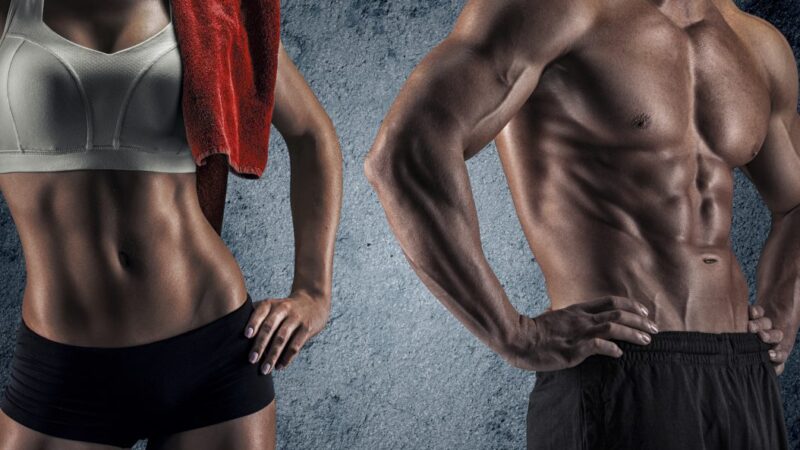
Influencers on the internet fight with each other for your attention. That may involve finding the hottest take to talk about, but more often it involves finding the best lighting, the best angles, the best clothing, the lack of clothing, and even the perfect pump to get people hooked in. A “healthy lifestyle” now has its own culture and look attached to it, despite all the work the well-intended of the industry has put into embracing and validating diversity and the “it depends” narrative mentioned earlier.
People who consume the content of the influencers join the party in a different way: A sadder, unhealthy, victimized way via comparison culture.
Be it through finding the most “optimal” way to do things via the loudest voice with the biggest following, or be it through sizing ourselves up to the jacked-and-tanned physiques that have literally made it their job to look this way – it’s all damaging to mental health.
Today, many people are entering fitness in hopes of improving their confidence, mental health and self-image, immediately immerse themselves into an ecosystem designed to compromise all three. And since there’s always someone stronger, leaner, or living “better” via the highlight reel they post to gain followers, the finish line keeps moving. A person may think he’s disciplined until another 27 year old, childless influencer reveals their only half-true 4:30AM routine, supplement stack, ice bath protocol and morning sunlight exposure regimen.
Welcome to a generation of people who no longer know how to train without psychologically auditing themselves every step. Training intuitively? Perish the thought. The internet is too busy concocting the perfect recipe for chronic dissatisfaction, with your name on it; a true negative feedback loop.

The danger of the internet content in the present day and age, is that it’s all performative. You don’t get in great shape for yourself anymore, but you say you do to appease your audience comprising of strangers and avatars. Similar to other very exclusionary corners of the industry, the movement at its core seems innocent, but proves to be pernicious and toxic in its own right. What was once a healthy hobby becomes an identity with either way too much or way too little positive reinforcement.
In trying to correct the toxic extremes of old fitness culture, we’ve accidentally created a shinier, more socially palatable and politically correct version of the exact same problem.
Somewhere in the Middle
This pendulum swing went wrong, but it was still necessary. The positive, like I mentioned at the outset, has been more people lifting, and more people understanding the value of muscle and mobility than ever. In the last 19 years, I’ve trained enough people to know what things look like when those things aren’t a prioritized part of the lifestyle.
But now the internet has made people observe fitness, or analyze fitness, instead of participate in it. Too many people are forgetting what quietly putting the head down and doing the work feels like. If they’re young enough, some never learned what that should feel like at all.
Every workout won’t be perfect, and every set doesn’t need to be optimized right down to the rep. Your skin will fold when you sit down and there will be days when you feel bloated, crappy, and look “worse” than others. Your fitness doesn’t depend on those instances, nor anything else other than consistency.
If you’ve read this far, be proud. You’ve demonstrated that you’re not a prisoner to the fast-hit dopamine fodder of social media. This was a 1300-word read with no “3 second hook”, and no AI editing assistance.
Maybe that serves as a subtle cue to periodically take a break from the doom scroll, and see how it makes you feel – and how it makes you train.
But don’t just do that because I said so on the internet.


